
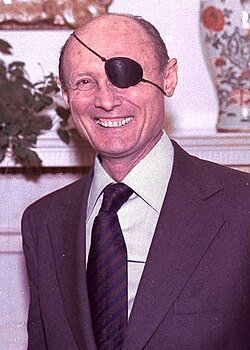
Moshe Dayan
1915 – 1981|The fourth Chief of Staff of the IDF and a minister in Israeli governments
Story
Moshe Dayan (ListenⓘⒾ, May 20 1915, 7 Sivan 5675[2] – October 16 1981, 19 Tishrei 5742) was a military commander, statesman and public figure in Israel. Beginning as an officer in the Haganah and the Palmach, Dayan rose through the ranks until his appointment as the fourth Chief of the General Staff of the IDF, which he commanded during the Sinai Campaign. He was a Member of the Knesset and a minister in Israeli governments. He served as Minister of Defense during the Six-Day War, the War of Attrition and the Yom Kippur War, and as Foreign Minister in the government of Menachem Begin at the time of the signing of the peace treaty with Egypt.
In his personality, Dayan embodied the type of the "Sabra" – a son of the labor settlement movement, holding a rifle in one hand and a plow in the other. As Chief of the General Staff, Dayan was seen as one of those who shaped the spirit and character of the IDF as a strong army with an offensive and proactive nature.
As Minister of Defense, Dayan was perceived by the public both as one of those responsible for the great victory in the Six-Day War and, alongside the head of Military Intelligence Eli Zeira, as primarily responsible for the failure in the Yom Kippur War. In proportion to the admiration the public felt toward him before the war, so was the depth of the crisis of trust toward him in the period that followed. Dayan sought to overcome the crisis, and in his final years, while serving as Foreign Minister, he contributed from his experience and from his diplomatic and security expertise to shaping the peace agreement with Egypt. Dayan the man, his diplomatic and security outlook, his turbulent personal life, and his exceptional and controversial personality had a great influence on the State of Israel in the first three decades of its existence.
Many preferred to see him in roles befitting his skills and his military and diplomatic experience, and to benefit from his practical, matter-of-fact approach, despite moral blemishes attached to his image, such as love affairs, antiquities looting, disdain for the law, and harsh treatment of his family. These, together with his performance in the Yom Kippur War, undermined his public image after his death.
Early Life (1915–1930)

Moshe Dayan with his parents, Devorah and Shmuel Dayan, 1918
He was born on May 20, 1915, in the kvutza of Degania (later called "Degania Alef", then part of the Vilayet of Syria of the Ottoman Empire), to Shmuel Dayan and Devorah née Zatolovsky, members of the Second Aliyah, as the eldest son in the family, and was the second child born in the kvutza (after Gideon Baratz,[3] who was born in the kvutza in 1913[4]). In February 1922[5] a sister, Aviva, was born (the mother of Yehonatan Geffen), and in 1926[6] a brother, Zohar, was born. Dayan was named after Moshe Braski, the first member of Degania to be murdered by Bedouin robbers. The murder occurred on November 22, 1913, while Braski was riding to Menachemia to bring medicine for Shmuel Dayan, who had fallen ill.[7]
When Dayan was six years old, his parents decided to join the founding core group of the first moshav ovdim, and so the family moved to Nahalal in the year of its founding.[8] Dayan attended elementary school in Nahalal. When he grew older, he moved to the agricultural high school, where he completed his studies, even though it was then a school for girls. Already in childhood he took part in security tasks in the moshav, and in 1930, at the age of 15, he was initiated into the secret of the "Haganah" organization.[9]
Military Career (1930–1958)
In the Service of the Haganah (1930–1947)

The ascent to Hanita, 1938. From right: Yigal Allon, Yitzhak Sadeh, Moshe Dayan
In 1936 another wave of unrest began, the 1936–1939 Arab revolt. During this period the authorities of the British Mandate permitted the establishment of the Jewish Settlement Police, which was composed mainly of members of the Haganah organization, known as "notrim" (supernumerary police). Dayan enlisted on May 25, 1936, and was among the first notrim.[10] After serving for a short time as a guide in the British Army, Dayan joined the Jewish Settlement Police. In December 1937 he was a trainee in a platoon commanders' course, which was instructed by Yitzhak Sadeh, and among his fellow trainees was also Yigal Allon. In 1938–1939 he was a member of the "Field Companies," which Sadeh commanded, and took part in the operations of the "Special Night Squads," which were commanded by Wingate. In these frameworks he learned the principles of offensive combat doctrine, which served him throughout his military career. On March 21, 1938, he took part, within this framework, in the ascent to kibbutz Hanita.[11] In a famous photograph from that period, Allon, Sadeh and Dayan are seen, with Sadeh embracing Allon on his right and Dayan on his left.

Part of the squad commanders' course (Mem-Gimel) at the Zrifin detention camp. Moshe Dayan is on the right.
On 5 October 1939 he was arrested – as one of the Thirty-Five Haganah Prisoners – and was put on trial for illegal possession of weapons. Dayan was sentenced to ten years' imprisonment, which he began serving in Acre Prison and in the Mazra'a detention camp. World War II meant that the British Army needed the support of the Yishuv, and cooperation began between the British Army and the Jewish underground organizations. Recruitment of members of the Yishuv into the British Army began, and within this framework the leadership of the Yishuv and the authorities of the British Mandate agreed on the release of the Thirty-Five on 17 February[12] 1941. When Dayan was released from prison, the situation in the Middle East was dangerous. In Iraq, the pro-Nazi Rashid Ali al-Gaylani revolt against British rule began; in the Western Desert, the armies of the Axis advanced toward Egypt and the Land of Israel; and in Syria and Lebanon, which were under French mandate, the army of Vichy France ruled, which obeyed the collaborationist regime of Marshal Pétain. Under these circumstances, Yitzhak Sadeh and others began organizing a force (later known as the Palmach) that would assist the British in reconnaissance and small-scale warfare. Dayan was appointed by Yitzhak Sadeh as commander of Company B of the force (Company A was commanded by Yigal Allon). In June 1941, as part of the invasion of Syria and Lebanon, a force of the 7th Australian Division was to move along the coastal road north of Rosh HaNikra, with the aim of preventing the French from blowing up the bridges over the Litani River, and thus enabling the free movement of British forces along the coastal road to Beirut. Dayan was attached to the Australian force as a guide, and during this operation a French sniper hit the binoculars Dayan was holding; shards of glass and metal splintered from them struck his left eye, and he lost his sight in it.[13] At the beginning of August he was released from the military hospital.[14] From then on Dayan used to cover his injured eye with an eye patch, and the patch became a kind of symbol identified with his image. After recovering from his wounds, Dayan returned to his farm in Nahalal and continued his activity within the "Haganah." In 1945 he moved to Tel Aviv, and in December 1946 he traveled to Basel to serve as a delegate to the Zionist Congress.[15] During these years (1939–1945) Dayan's three children were born – the eldest, Yael, Ehud (Udi) and Assaf (Assi).
On 2 February 1947[16] he was called upon by Yaakov Dori, who was then Chief of Staff of the Haganah (and later the first Chief of Staff of the IDF), to serve as an "Arab Affairs Officer."[17] It was clear to everyone that the War of Independence was fast approaching.
In the War of Independence (1947–1949)

Chief of Staff Moshe Dayan
In April 1948, after the Battle of Ramat Yohanan, Dayan took part in talks with Druze officers in the Arab Liberation Army, aimed at forging a secret "blood covenant" between the Druze and the Jews. He took part in these discussions even though only a few days earlier his brother Zorik had been killed in the Battle of Ramat Yohanan, fighting against Druze fighters.[18][19] The talks ultimately led to cooperation between the Druze and the Jews.
Dayan began the war in staff positions, with the rank of major, at the side of Chief of Staff Dori. In May 1948, however, he was sent to command IDF forces in the Jordan Valley, and took part in halting the Syrian forces at Degania, where he was born. After the Battle of Degania, at the end of May 1948, he was appointed commander of the battalion 81 (later 89), nicknamed the "Commando Battalion,"[20] a mechanized battalion specializing in raids in the 8th Brigade, which was commanded by Yitzhak Sadeh.[21] During a truce in the fighting he traveled to the United States to attend the funeral of Major General David Marcus. After returning to Israel, in July 1948, he took part with his battalion in Operation Dani.[22]

Moshe Dayan during Operation Danny, after the raid on Lod

Statue of Moshe Dayan at Operation Danny Square in Ramla
During Operation Danny, he led a daring jeep raid by his battalion into the city of Lod on July 11, 1948, in which 9 fighters were killed and 17 were wounded.[23] Opinions differ as to how significant this raid was in the capture of Lod, which subsequently led to the capture of Ramla.[24] In any case, the capture of Lod was actually carried out by soldiers of the Yiftach Brigade, and it appears that the raid contributed to undermining the morale of the defenders.[25][26]
After Operation Danny, Dayan's battalion was transferred to the southern front, as part of Operation Death to the Invader, where it fought against Egyptian forces. On August 1, 1948, Dayan took up the post of commander of the Etzioni Brigade[27][28] and was promoted to the rank of Lieutenant Colonel, which at that time was one rank below Major General (the ranks of "Colonel" and "Brigadier General" had not yet been introduced). Because of ambiguity regarding his authority in the Jerusalem area relative to that of the Central Command general, the committee of Haim Laskov decided to appoint Dayan concurrently as commander of Jerusalem as well, replacing Major General David Shaltiel. In that capacity, he was even granted official residence at Villa Leah, a grand building by the standards of those days, in the Rehavia neighborhood of Jerusalem.
At this stage the significant battles in this sector had ended, and most of Dayan's activity consisted of attempts to improve positions against the Jordanian Legion, in preparation for the future negotiations over the status of the city. However, even after the Second Truce took effect, the Arabs continued to snipe and shell from time to time from the area of Government House, causing casualties among soldiers and civilians. Dayan sought to capture a hill on the western spur of the Government House hill that lay in the demilitarized zone, in order to prevent Arab fighters from firing from it toward Talpiot. He disregarded the warnings of officers of the Etzioni Brigade that the hill was under Arab fire from Government House, and on the night between 17 and 18 August 1948, forces from the 62nd Battalion ("Beit Horon") of the Etzioni Brigade, under the command of Meir Zorea, set out and took the hill without resistance. But at dawn they were discovered by the Arabs, who opened fire, supported by artillery. The Etzioni fighters were caught exposed in open ground. Zorea asked for permission to enter Government House, but according to his claim in the subsequent inquiries, the brigade commander, Dayan, was not at his headquarters to approve the entry. With no alternative, an order to withdraw was given. The Arabs stormed the hill and captured it. The Etzioni Brigade's losses were heavy: 14 killed, 24 wounded and 5 taken prisoner.
On 19 October 1948 Dayan commanded Operation Yekev. The aim of the operation, which was the Etzioni Brigade's first full brigade-level operation, was to capture the Beit Jala ridge, near Bethlehem, on which Egyptian forces were positioned. A single enemy machine gun managed to halt the forces of the Moriah Battalion, who were advancing in single file up the mountain. At the same time, the forces of the "Beit Horon" Battalion were operating; they succeeded in their mission to capture "Har HaTa'ala" (at a cost of 7 killed) and even began organizing to defend it, but Dayan gave an order to withdraw and the operation was canceled.[29]
As part of his role he served as a diplomat in contacts with the Jordanians, and even with King Abdullah. His interlocutor in these contacts was the Jordanian commander of Jerusalem, Colonel Abdullah el-Tell. In December 1948 the two reached an understanding that neither side would initiate any further military action, an understanding that preceded by four months the armistice agreement between the two states. The agreement fixed the status of the Israeli enclave on Mount Scopus and allowed convoys to pass to and from the enclave.[30]
In March 1949 Dayan was one of the negotiators in the delegation to the armistice talks between Israel and Jordan, which were held on the island of Rhodes.[31] On 3 April 1949 the agreement between the representatives was signed. The delegation was headed by Dr. Walter Eytan, and in addition to Dayan, Reuven Shiloah also joined the delegation.
Military Career up to His Appointment as Chief of the General Staff (1949–1953)
After the end of the war, Dayan ran for office and was even elected to the First Knesset on the Mapai list, placed tenth on the Knesset list,[32][33] but at Ben-Gurion's request he remained in the IDF and on 21 October 1949 was appointed Commander of the Southern Command and promoted to the rank of Aluf (Major General).[34] This was a period of relative calm following the war, during which Dayan completed a nine-month battalion commanders' course, alongside his service as a regional command chief. After completing the course, Dayan was sent to a senior commanders' course in Britain. Upon his return, in May 1952, Chief of the General Staff Yigael Yadin offered him the post of his deputy. Dayan declined, and was instead appointed Commander of the Northern Command,[32] a position in which he served for about half a year.
In December 1952, following the resignation of Chief of the General Staff Yigael Yadin, Dayan was appointed by the new Chief of the General Staff, Mordechai Maklef, as head of the General Staff Branch (Agam).[35] Maklef stipulated in advance that he would serve as Chief of the General Staff for only one year, and Dayan's appointment as head of the General Staff Branch marked him as Maklef's successor. During this period he was supported by a small circle of close associates, among them the head of his bureau, Major (later Major General) Shlomo Gazit, his secretary Naura Matalon (later Barnach-Matalon), and his driver Noam, who had been wounded in the War of Independence. According to Barnach-Matalon, the office of the head of the General Staff Branch during Dayan's tenure looked like a field command tent and included many elements typical of military activity in the field.
Dayan's period as head of the General Staff Branch (Agam) was a stormy one. Attempts at infiltration and sabotage were met with reprisal operations, and Unit 101 was established, commanded by Ariel Sharon. After the unit was merged with Battalion 890, Dayan appointed Sharon as the battalion's commander. When the Qibya operation was carried out on 14 October 1953, in which dozens of civilians who were inside houses blown up by Unit 101 during a reprisal operation were killed, Dayan set out to defend the position of Israel in the United Nations General Assembly.[36]
Chief of the General Staff (1953–1958)

Moshe Dayan reviewing the graduation parade of an officers' course at Bahad 1 in Jerusalem (in the background, the Government Compound). 1955
The Lavon Period (1953–1955)
Dayan was appointed Chief of the General Staff on 6 December 1953,[37] and the following day David Ben-Gurion retired from his posts as Prime Minister and Minister of Defense, transferring the premiership to Moshe Sharett and the post of Minister of Defense to Pinhas Lavon.[38]
The relationship between Lavon and Dayan was not good from the outset, and during Dayan's tenure as Chief of the General Staff under Defense Minister Lavon, relations deteriorated even further. Lavon belonged to the middle generation in Mapai and was Dayan's political rival. In the spirit of those days, Dayan was a member of the Mapai Central Committee and resigned from it only once he was appointed Chief of the General Staff. Lavon saw himself as Ben-Gurion's successor, a view that put him on a collision course with the group of young men Ben-Gurion had nurtured, headed by Dayan and Shimon Peres, who served as Director-General of the Ministry of Defense. Although the two men, Dayan and Lavon, held a similar security outlook, disputes soon began between them, which were expressed even in matters of principle, such as Dayan's demand to purchase tanks of the AMX-13 type from the French, on which Lavon imposed a veto, despite the recommendation of the General Staff.[39]
The struggle over authority between the Minister of Defense and the Chief of Staff created a lack of clarity regarding direct contact between senior officers and the Minister of Defense. When Dayan learned in mid-1954 that the Air Force commander Air Force Dan Tolkowsky had met directly with Lavon, he submitted his resignation, but was persuaded by David Ben-Gurion to withdraw it. Lavon insisted on his right as Minister of Defense to continue meeting with IDF commanders, among them the head of Military Intelligence, Colonel Binyamin Gibli. This would later be of decisive importance regarding the question "who gave the order" to Gibli in the affair known as "the Lavon Affair" (literally, "the Unfortunate Business"). An unidentified party ordered the activation of a network of Jewish spies in Egypt, and instructed them to sabotage British facilities, in order to prevent Britain's withdrawal from the Suez Canal area. When the order was given to Gibli, Dayan was visiting the United States, and Lavon denied having given the order. Gibli claims that Dayan gave the order without informing Defense Minister Lavon.[40] The affair was of decisive importance in the political history of the State of Israel, and years later, in 1963, it led to Ben-Gurion's resignation as prime minister.
Dayan's relations with Prime Minister Moshe Sharett were also strained.[39] Dayan was a man of the activist line, and believed in the deterrent power of the IDF and in its ability to go to another war and win it. By contrast, Sharett was a conciliator, and tried to find channels to the Arab rulers in order to reach peace arrangements. Sharett's room for maneuver was limited. He was caught between the activist line of Dayan (and also of his rival Lavon), which favored numerous retaliatory operations that diminished the chance of diplomatic contacts, and the fact that many of the important decisions were not made in Jerusalem but at Sde Boker, Ben-Gurion's residence.
Following the failure of "the Lavon Affair," Lavon demanded the dismissal of Dayan, Gibli, and also Shimon Peres. A decision became necessary as to which of the two, Dayan or Lavon, would stay and which would be dismissed. Such a decision was beyond Sharett's power, and in the end Lavon resigned from his post and was replaced by Ben-Gurion. If Sharett harbored any hope of gaining some influence over the course of events, Ben-Gurion's return to the Ministry of Defense put an end to that hope, since Ben-Gurion was the one who had run the state during its first 15 years. In Ben-Gurion, Dayan found a full partner to his vision regarding the capabilities of the IDF and the way in which they should be used.
The Retaliatory Operations (1955–1956)

IDF commanders with the fighters of the Paratroopers Brigade, 1955. Standing, right to left: Colonel Asaf Simchoni, Lieutenant Moshe Efron, Captain Danny Matt, Lieutenant General Moshe Dayan, Lieutenant Colonel Ariel Sharon, Lieutenant Meir Har-Zion. Kneeling, right to left: Captain Rafael Eitan, Lieutenant Yaakov Yaakov, Captain Aharon Davidi.
Ben-Gurion returned to the Ministry of Defense in February 1955, and a few months later, following the elections to the Third Knesset, he returned to the office of prime minister as well. A period of cooperation between Ben-Gurion and Dayan now began, against the background of a steadily worsening security situation, particularly on the southern front. The regime of Gamal Abdel Nasser, which had replaced the monarchy in Egypt, was forceful in its rhetoric against Israel, and it appeared that he intended to take practical steps. An arms deal between Egypt and Czechoslovakia, made public in September 1955, aroused grave fears that the Egyptian ruler was indeed set on war with Israel. At the same time, Egypt tightened the blockade on Israeli shipping in the Gulf of Eilat. However, the main, daily problem facing Israel was the fedayeen attacks, which in those years had become a brutal and incessant onslaught.
Dayan believed that the fedayeen problem should be dealt with through large-scale operations against the regular forces of the states from which the fedayeen emerged. At the end of February 1955, IDF soldiers under the command of Ariel Sharon raided Gaza in an action known as "Operation Black Arrow," in which about 37 Egyptian soldiers were killed. Another large-scale action of this kind was carried out at Khan Yunis on 31 August 1955 ("Operation Elkayam"), in response to a fedayeen attack that claimed seven civilian lives. In the Khan Yunis operation, commanded by Mordechai Gur, about eighty Egyptian soldiers were killed. Another action at Kuntilla at the end of October left 10 Egyptian soldiers dead.[41]
In response, the Egyptian army seized an area near Nitzana. After several days in which diplomatic efforts failed to bring about the withdrawal of the Egyptian forces, the IDF repelled the Egyptian brigade in a night battle ("Operation Volcano"), in which about fifty Egyptians were killed, compared with seven Israeli soldiers. The mutual raids turned into real battles, in which even armor and artillery were involved. In his book Diary of the Sinai Campaign, Dayan writes that "Israel's responses presented the Arabs in an ultimate form with the choice: maintain the peace or go to war." At this stage, in light of the Czechoslovak-Egyptian arms deal and the closure of the Straits of Tiran, Dayan believed that Israel should take the offensive initiative and thereby preempt an Egyptian initiative. The retaliatory operations became a steadily growing escalation, and they provoked a counter-response, which in turn required more frequent and more severe retaliatory operations.
In December 1955 the IDF raided Syrian outposts in the Sea of Galilee area (Operation Olive Leaves), in the largest action undertaken up to that time. In April 1956 there was a real escalation in the reciprocal actions, and seventeen Israeli soldiers were killed. At the grave of Roi Rothberg, a member of Kibbutz Nahal Oz in his early twenties, who was murdered by Arab infiltrators after they dragged him across the border and abused him, Dayan delivered a eulogy on 30 April 1956, revealing his outlook on the Israeli-Arab conflict:[42]
Yesterday at dawn Roi was murdered. The stillness of the spring morning dazzled him, and he did not see those lying in wait for his life along the furrow's edge. Let us not cast blame on the murderers today. Why should we argue against their hatred of us? For eight years they have been living in the refugee camps in Gaza, and before their eyes we are turning into our own inheritance the land and the villages in which they and their fathers dwelt. It is not from the Arabs of Gaza, but from ourselves, that we must demand Roi's blood... We are a generation of settlement, and without the steel helmet and the cannon's muzzle we cannot plant a tree and build a house... Beyond the furrow of the border swells a sea of hatred and desires for revenge. A hatred that awaits the day when tranquility will dull our alertness. To us, and to us alone, cries out the blood of Roi from his torn body. For we have sworn a thousand times that our blood shall not be spilled in vain, and yesterday once again we were tempted, we listened and we believed... Let us not shrink from seeing the hatred that inflames and fills the lives of hundreds of thousands of Arabs who dwell around us. Let us not avert our gaze, lest our hand weaken. This is the decree of our generation, this is the choice of our lives – to be ready and armed, strong and unyielding – or else the sword will fall from our fist and our lives will be cut down... Roi the young man – the light in his heart blinded his eyes and he did not see the glint of the blade. The longing for peace deafened his ears and he did not hear the voice of the murder lying in wait.
These words express a worldview that rejects the possibility of a political solution and holds that, given the basic facts of Israeli existence within the Arab world, Israel must respond with force in order to achieve deterrence. The "Dayan Doctrine" in those years was that in any case of Arab military buildup, arming, unification of the Arab leadership and tightening of the siege on Israel, a preemptive response should be taken. In later years this approach would give way to the question he asked in his last book – "Shall the sword devour forever?".
The Qalqilya Operation (1956)

Main article – The Qalqilya Operation
In the summer of 1956 the conflict on the Jordanian border escalated. The regime of the young King Hussein had to maneuver between various factions, and was under pressure from the regime of Gamal Abdel Nasser. In September 1956 Hussein concluded a defense pact with Nasser. Dayan was convinced that the fedayeen, whether they were attacking in the south or in the center, were a unit of Egyptian intelligence. Nevertheless, Jordan tried to tighten its relations with Iraq, and Hussein even discussed with King Faisal the entry of Iraqi forces into Jordan. Whether due to Iraqi influence or as a result of Egyptian pressure, the situation on the border worsened considerably. In infiltrator attacks on the Jordanian border civilians were killed, while the IDF responded with a series of reprisal operations that grew ever more severe. About two days after the murder of three workers near Tel Mond, on October 11, 1956, Dayan ordered the largest operation the IDF had carried out since the War of Independence: the attack on the Jordanian police building in Qalqilya. The IDF lost eighteen fighters, but the Jordanians lost eighty-eight of their men. Taking part in the operation were the paratroopers, armor and artillery. During the operation, a blocking force that had been positioned behind the city was surrounded, and was extracted after a difficult battle.
The operation was the last in the series of large reprisal operations. It appeared that they had exhausted their deterrent capacity, and they endangered the alliance that was taking shape with Britain and France in preparation for the Sinai War,[43] and worst of all, the Egyptians and the Jordanians had learned the method of operation, and now knew to expect an attack on a military installation when they heard of fedayeen activity in Israel.
In the Sinai War (1956)
Main article – Sinai War
Toward the War
In 1956 the leaders of the State of Israel felt that an Arab noose was tightening around it. The nationalization of the Suez Canal by Nasser, which together with the naval blockade that Nasser declared on Israeli shipping in the Red Sea, became a naval siege of the State of Israel; the border conflicts, alliances and coordination among Syria, Egypt and Jordan, and especially large arms deals, as well as the exhaustion of the "reprisal operations" method – all these led to the conclusion that a war was necessary in order to break the noose.
Following the nationalization of the canal, France and Britain, the canal's former colonial masters, also decided to use force against Nasser in order to regain control of the canal. France was the principal proponent of Israel's participation in the plans, whereas Britain was torn: on the one hand, it desired Israeli cooperation in Sinai, and on the other, it was party to a mutual defense pact with Jordan, which might have obligated it to act against Israel under certain conditions.
At the end of September, Dayan, together with Golda Meir, Moshe Carmel and Shimon Peres, traveled to Paris to coordinate operations with the French Chief of Staff, General Ely. The plan reached in these talks was that Israel would attack Egypt in order to eliminate the fedayeen activity, while Britain and France would then join in, occupy the canal zone and hold it, ostensibly "in order to separate the belligerents." Dayan gave the French a list of the equipment required for the operation – 100 tanks, a squadron of transport aircraft, 300 front-wheel-drive trucks, and more. After his return to Israel, Dayan issued the General Staff an alert order for a campaign against Egypt.
After the parties failed to reach an agreed plan of action, another meeting was held in the Paris suburb of Sèvres, attended by the British, the French, and also Dayan, Ben-Gurion and Shimon Peres. After the conference it was clear that the Israeli attack would come within a few days.
The plan that took shape involved a bold offensive, based on dropping a force deep in enemy territory and linking up with it through the deployment of armored and infantry forces. In effect, the war would begin with the capture of the final objective – the area adjacent to the Mitla Pass, near the Suez Canal.
Stages of the Fighting

Chief of Staff Dayan reviewing a victory parade at the end of the Sinai War. At his sides: Southern Command commander Asaf Simhoni, and commander of the 9th Brigade Avraham Yaffe

Dayan during his visit to Vietnam
The war began on 29 October with the parachute drop of the 890th Battalion of the Paratroopers Brigade, commanded by Rafael Eitan, near the Parker Memorial close to the Mitla Pass. Armored and infantry forces broke through at several points toward the canal, Sharm el-Sheikh and the Gaza Strip. As previously agreed with Israel, the British and the French sent an ultimatum to both sides to withdraw their forces, so as to allow a British and French takeover of a ten-mile-wide strip along the canal. Israel ostensibly accepted the ultimatum, while Egypt rejected it. The ambassador to the UN, Abba Eban, remarked sardonically that in order to comply with the terms of the ultimatum, the State of Israel would have had to "withdraw its forces forward."
As Chief of the General Staff, Dayan played a major part in shaping the war during the preparation stage, before the opening of fire. As noted, he was among the activist figures who pushed for broad action, in order to remove the threat of the fedayeen, the naval blockade and the threat of an Egyptian attack ("the second round"). However, he also insisted that the opening move should mislead the Egyptians into thinking that Israel was aiming at a limited operation, a kind of reprisal action like those that preceded it. This stemmed from the agreement Israel had signed with Britain and France, its partners in the war, and for this reason Dayan also refrained from revealing his intention to the IDF commanders – a fact that caused serious misunderstandings. Dayan set the priorities for force build-up, favoring infantry over armor and setting the main effort on the northern axis – some of which proved to be mistaken preferences, according to several researchers.[44] However, during the fighting itself he rarely intervened in the conduct of the battles, and for the most part left this to the commanders in the field. Exceptions to this were the instructions he gave directly to the commanders of the 7th Brigade and the 10th Brigade.[45]
Disputes
In two instances during the war, field commanders took the initiative and acted contrary to the original plan, which led to disputes and quarrels after the war, dubbed "the Generals' Wars." The first instance was, in the view of most commanders and researchers, a move that decided the fate of the Sinai War.[46] The Southern Command chief, Asaf Simhoni, initiated the commitment of the 7th Brigade to the campaign earlier than planned, because he feared that with limited forces the IDF would fail in its mission. In his view, which was later accepted as a guiding principle in IDF combat doctrine, employing armored forces in full units is the preferable option on the modern battlefield, because of the great advantage of armor in firepower and in rapid movement and maneuver. By contrast, Dayan still adhered to the concept that had prevailed eight years earlier, in the War of Independence, whereby infantry is the main force and armor supports it. Therefore Simhoni ordered, contrary to Dayan's directive, not to split the 7th Brigade into combat teams; he sent its commander, Uri Ben-Ari, on the second day of the war (30 October) to help capture Kusseima, and to break through the road to Umm Katef in order to encircle the Egyptian army at El Arish, and to block the path of possible reinforcements along the central axis in Sinai.
Some argued that Simhoni's decision endangered the success of the operation, because had it turned out that the powers were backing out of the agreement and not fulfilling their part, then from the moment of the transition to full-scale war the IDF would have had no way back. By contrast, most IDF officers and researchers held that the move brought about a faster collapse of the Egyptians, and the completion of the mission in a short time and with fewer casualties.
As a result of a communications breakdown between the Chief of Staff and the General Headquarters command post (Matzpa) on the one hand, and the Southern Command headquarters on the other, stemming mainly from Dayan's habit of being absent without notifying how he could be reached,[47] the Southern Command chief, Simhoni, found it difficult to coordinate his moves with the Chief of Staff in real time. Dayan heard about the change in the plan later that same day, and apparently approved it retroactively.[48] Dayan treated the violation of the order with leniency, and in a kind of admission of his own error, coined the famous saying: "With all the resentment I felt over the breach of discipline, it is better to struggle with noble steeds when the problem is how to rein them in, than to push and urge on oxen that refuse to move."[49]
The second case of violating an explicit instruction was the initiative of Ariel Sharon to capture the Mitla Pass, in a battle that claimed many casualties. There is still a dispute regarding the benefit of the Battle of Mitla. Most researchers agree that the outcome of the battle did not serve any immediate operational need,[50] and that its main benefit lay in the creation of a new myth, with a powerful educational influence; accordingly, the battle helped set new and higher standards of military norms, such as dedication to the mission, determination and heroism, and in instilling them in the rest of the IDF units. Dayan himself determined that "the courage, daring and aggressiveness of the paratroop commanders are virtues that should be cultivated and encouraged, but this campaign was not essential." Ariel Sharon's advancement was also not harmed as a result of the violation of Dayan's order. The battle at the Mitla Pass (which Dayan considered unnecessary) claimed thirty-eight lives. Dayan brought Sharon before Ben-Gurion, who was also presented with an investigation report by Haim Laskov. As Chief of Staff, Dayan in effect gave full backing to an action that led to many casualties, and in doing so paved the way for Ben-Gurion to avoid a decision, because, in his words, it was not appropriate for him to rule on the military question.
Results of the War
In less than a week the IDF conquered the Sinai Peninsula and the Gaza Strip, and also won an important victory at sea, when it captured the Egyptian destroyer "Ibrahim el-Awal", which had tried to shell Haifa from the sea. The total cost in human lives was 172 dead. Politically, the State of Israel did not succeed in reaping the fruits of the operation and holding on to the conquered territories. Another secret objective may have been to topple Nasser's regime (this was one of the aims of Britain and France), and this goal too was not achieved – on the contrary, Nasser's standing was greatly strengthened. But militarily the operation was a success: Egyptian military infrastructure in Sinai that had supported the fedayeen operations was destroyed, the naval blockade was lifted, and the IDF demonstrated the ability to operate armored units over a wide area, while the infantry displayed a fighting spirit that had been lacking until then in the IDF as a large army. Accordingly, Dayan's public prestige rose, and he became a figure known throughout the world.
Retirement from the Position of Chief of Staff (1958)

Prime Minister David Ben-Gurion pins the Haganah medal on Dayan (on the right: Yigael Yadin), Jerusalem 1958.
Dayan was one of the leading opponents of Israel's withdrawal from the territories it had captured during the Sinai Campaign.[51][52] He believed that insufficient guarantees had been given that the Gaza Strip would not once again become a base of terror that would embitter the lives of the country's residents. He did not hesitate to express his opinion, even before the secretariat of Mapai, which he addressed wearing civilian clothes, before the Knesset vote on approving the withdrawal. When his opinion was not accepted, he attended the ceremony marking the evacuation of IDF forces from El Arish, and there he remarked that "commanders must eat all of the IDF's rations, both the tasty and the bitter."
After the IDF withdrawal was completed, he went on an extended leave, which included a tour of many countries around the world. On January 29, 1958, he officially ended his term and was replaced by Haim Laskov.[53][54]
Political Career (1959–1981)
Until the elections to the Fourth Knesset, Dayan studied political science and Middle Eastern studies at the Hebrew University. Ahead of the elections, Dayan, a lifelong member of Mapai, replaced his father Shmuel Dayan on the Mapai list for the Knesset, and entered the Knesset on November 30, 1959.
Minister of Agriculture (1959–1964)
Dayan was appointed Minister of Agriculture in Ben-Gurion's government and served in this post for five years, from 1959 until 1964. This role was far from Dayan's character, inclinations and aspirations, but the senior posts he desired were given to veteran Mapai members. Israeli agriculture in those years was under the control of powerful organizations and long-established monopolies, and the Minister of Agriculture's influence was marginal. This period is remembered for Dayan's attempt to shift Israeli farming to growing the "Moneymaker" variety of tomato, which was suitable for export, in place of the local "Marmande" variety to which the local consumer had grown accustomed. This attempt met with fierce opposition and ultimately failed completely.
As a politician, Dayan was dragged, against his will, into the intergenerational dispute within Mapai. Ben-Gurion tried to cultivate a generation of young people, among them Dayan, Shimon Peres, Abba Eban and Teddy Kollek. Members of the Third Aliyah, such as Pinhas Lavon, and especially "the Troika" – Golda Meir, Zalman Aran and Pinhas Sapir – felt that Ben-Gurion was about to pass the torch of leadership over their heads to the younger generation, without giving them the opportunity to lead. In the background of the conflict was Ben-Gurion's demand to continue investigating "the Lavon Affair" and to denounce Pinhas Lavon as the one who had given the "order."
When Ben-Gurion resigned for the last time, on June 16, 1963, and announced that his successor as Prime Minister and Minister of Defense would be Levi Eshkol, Dayan too announced his resignation, claiming that he could not bear collective responsibility as a member of the government. Many called at the time to hand him the defense portfolio, since Eshkol, who until then had served as Minister of Finance, did not appear to have the suitable background for the position. Dayan, who as early as 1958 had delivered a speech in which he distinguished between "the Israeli youth who crawled among thorns and stones with a rifle in hand" and "those who sat on the fifth floor of the Executive Committee," saw himself as a candidate for the post. In Eshkol's government, he not only did not receive the position he desired, but was forced to watch his political rivals grow stronger. At first Dayan announced his resignation from the government. Afterward, at Eshkol's request, he postponed the resignation "by two, three months." Eshkol urged him to remain in his post as Minister of Agriculture, and Dayan yielded to his entreaties.
In a speech he delivered shortly after the presentation of the government, he claimed that "the new collective leadership of Mapai must explain its path." Although this speech was answered by a sharp article by Zalman Aran in the Davar newspaper, in which Aran criticized Dayan as one who walks on "ideological crutches" provided to him by Ben-Gurion, rather than on his own legs, Levi Eshkol continued the negotiations, and in the end agreed to transfer a number of powers that had belonged to the Ministry of Finance to the Ministry of Agriculture, and kept Dayan in his government. During the following months, disagreements arose between Eshkol and Dayan, who felt that Eshkol was constraining his moves, until on November 4, 1964, Dayan announced his resignation from the post.
When Rafi was founded on July 22, 1965, the "young ones" joined it, but Dayan himself hesitated between the two options and "sat on the fence" (as the press described it at the time). At first he announced that he was remaining in Mapai and opposed the split, but later his concern grew that if he remained in Mapai he would be among the last, uninfluential Knesset members, and would not be able to advance his political and personal plans. Finally, on September 5, 1965, Dayan joined Rafi, which was energetically engaged in preparations for the elections to the Sixth Knesset.[55] This was only two days before the closing of the lists for the Knesset.[56]
The Political Desert
Rafi was one of the most resounding failures in Israel's political history. The party, headed by Ben-Gurion, aspired to be an alternative to Mapai's rule and to bring far-reaching changes to the country's political culture, but it won the support of only about 8 percent of the vote and secured only ten seats in the Knesset. Dayan was indeed elected to the Knesset, but Rafi remained in the opposition, and Dayan remained without any government or executive role. His activity in the Knesset was minimal, and he devoted most of his time to writing his book Diary of the Sinai Campaign and to other extra-parliamentary pursuits. During that period Dayan served as chairman of a joint council of Israeli fishing companies and, on behalf of the Resco company, went on a tour of appearances around the world to encourage investors to invest in Israel.[57] He left the burden of the party's day-to-day management to others, such as Shimon Peres, although in practice he did serve for some time as chairman of the party's Knesset faction.

Dayan during his visit to Vietnam, with soldiers of the United States Army
In 1966 he traveled to Vietnam, which was then in the midst of the Vietnam War, as a war correspondent for Maariv. He gathered his impressions in a series of articles that were published in the world press.[58] Dayan came away with the impression that the Viet Cong could not bring about the removal of the Americans from Vietnam, but he believed that the guerrilla war would continue for years, and that in order to win it and bring the Viet Cong to surrender, the Americans would have to offer an alternative answer to Vietnam's problems, one that would cause the Vietnamese people to oppose communism. His final conclusion was that "a prolonged campaign by the Viet Cong against United States forces can only be a guerrilla and terror war, in which the American advantage in the air, in artillery, in armor and in other technological means finds no military expression... The answer to guerrilla warfare is not technology, nor is it increasing the number of American soldiers. I do not believe the Americans can impose a peaceful life in Vietnam."
He used his stay in Vietnam to understand firsthand the American way of conducting modern war, on a scale unknown in the IDF which he had commanded, and making use of the modern technology of the time, such as the extensive use of helicopters.[59] His trip to Vietnam drew criticism in the Knesset and in the government. The matter of the trip was raised in a motion for the agenda by Knesset member Shmuel Mikunis, and during the debate that took place, Foreign Minister Abba Eban announced that although Dayan was entitled to travel wherever he wished, the visit to South Vietnam constituted "an offense against statesmanlike taste."[60]
Appointment as Minister of Defense (1967)
In 1967 the State of Israel was in the grip of a crisis that reminded many of the sense of strangulation it had experienced in the days before the Sinai War. This time, however, the posts of prime minister and defense minister were not held by David Ben-Gurion, the charismatic leader who had also embodied the nation's security, but by Levi Eshkol, who in the eyes of many was a drab party functionary who lacked an understanding of security matters.
A routine border incident with Syria set in motion a chain of events that led, in May 1967, to the entry of the Egyptian army into Sinai, the closure of the Straits of Tiran, and a general mobilization of reserves in the State of Israel and in the Arab states.
Hundreds of thousands of Israelis were called up, but the order to go into battle was slow in coming. "The waiting period" was a nerve-wracking time, in which many felt that, in the face of the existential threat, and given the IDF's proven ability to deal with it, Prime Minister Levi Eshkol was not adopting a resolute policy. The Chief of Staff, Yitzhak Rabin, could not withstand the tension and suffered a breakdown, but after two days of rest he returned to his post. Although the incident was kept secret, it contributed to a general sense of lost direction and indecision. The IDF generals warned that if Israel did not hurry to attack, it would itself be attacked, and would risk losing its air power. Eshkol, for his part, was under heavy international pressure, and the ambassador of the Soviet Union informed him that Israel must not take initiated action. Eshkol decided to address the nation in order to calm tempers.
In an unfortunate mishap, the phrase "Lines of action were also set for the redeployment of the forces" was replaced in the printing with "Lines of action were also set for the withdrawal of the forces," and he was unable to finish the sentence without hesitating and stammering. The public, which listened riveted to the speech on radio sets, was alarmed. At the cabinet meeting held afterward, heavy pressure was put on Eshkol to order the opening of the war.
Dayan watched with concern as events unfolded. As an opposition figure he had no influence whatsoever over events. But a broad public movement arose spontaneously and called for his appointment as defense minister. A women's movement (dubbed by the media "the Merry Wives of Windsor") began demonstrating in the streets for his appointment. Under pressure from the generals, among them his brother-in-law Ezer Weizman, as well as Yigael Yadin, whom he appointed as a special adviser, and even Menachem Begin, whom he asked to join his government, Eshkol was forced to agree to the appointment. His inclination had been to appoint Yigal Allon to the post, but public pressure took its toll, and the appointment was given to Dayan on June 1, 1967.
The appointment met with broad public approval. The public felt an immense sense of relief, and many behaved like people who had been saved from great danger. Michael Bar-Zohar described the spirit of the time in his book The Longest Month:
"Throughout the country, in cafés, in private homes, in IDF camps, on the decks of ships far out at sea, under camouflage nets, at the feet of tank tracks, spontaneous cries of enthusiasm broke out. Corks popped from countless bottles of cognac. 'I never suspected there was so much cognac in the IDF,' said a disciplinary sergeant major."
In the Six-Day War (1967)

Caricature (1967) of Dayan by Yoel Buchwald

In front, from right to left: Chief of the General Staff Yitzhak Rabin, Defense Minister Moshe Dayan, and Major General Central Command chief Uzi Narkiss entering the Old City of Jerusalem through the Lions' Gate after the Battle for Jerusalem. Behind them, looking backward, Major General Rehavam Ze'evi
In the eyes of the public, in the years after the war, Dayan's last-minute appointment was perceived as having saved the situation and brought about victory. In practice, the General Staff of the Six-Day War had been organized and prepared for the campaign for a long time. Officers who had served in junior and mid-level command roles in the War of Independence had reached maturity and intellectual independence, which made possible the planning and execution of a successful campaign. Dayan, who had been outside the defense establishment for about a decade, instilled in the public and in the fighters a spirit of decisiveness and determination, and to a large extent even marked out the political and territorial goals of the war; but it has been shown that he was not the central factor that brought about the victory.
In the days before the war, Dayan spread a fog of war, hinting that he did not foresee a war in the near future. At a press conference he held on June 3, he said, among other things:
It is too late to respond militarily to the Egyptian blockade of the Straits of Tiran, and too early for us to draw conclusions about the diplomatic route of handling this matter... Moreover, the hour is not suitable for it – we should have responded immediately, and since we missed the moment, we are obliged to let the statesmen exhaust all the possibilities in the diplomatic arena.[61]
Dayan released several thousand reservists and sent many others on short leave, all in order to heighten the element of surprise and to lower the Arab states' expectation of an Israeli attack.
However, the decision to appoint Dayan was tantamount to a decision to go to war, and on the morning of June 5, 1967, Dayan gave the order that IDF soldiers had been waiting for for about three weeks – aircraft of the Israeli Air Force launched an attack aimed at destroying enemy aircraft on the ground.
Dayan's contribution to the decisions made during the campaign lay mainly in setting objectives and in attempts to rein in the "galloping horses." On the southern front, on June 7 Dayan ordered a advance to the line of the Suez Canal, after having initially sought to avoid this. He also ordered, on June 6, the capture of the Old City, a decision of decisive political significance. At first, Dayan feared that a war against Syria would entangle Israel in a confrontation with the Soviet Union, but after further consideration, and after consulting with residents of the Galilee Panhandle communities who had suffered from Syrian shelling, and in light of the concern that a Security Council resolution on a ceasefire would deny the IDF achievements on the Syrian front as well, he changed his mind. On June 9, he ordered David Elazar, head of Northern Command, bypassing Prime Minister Levi Eshkol and Chief of the General Staff Yitzhak Rabin, to capture the Golan Heights. The IDF captured the Heights in less than two days.
The success of the war was complete. At its end, the IDF held the Sinai Peninsula and stood on the banks of the Suez Canal, in the Gaza Strip, in Judea and Samaria, in East Jerusalem, and on the Golan Heights. Dayan's personal popularity, as well as his political influence, reached a peak.
Between the Wars – Dayan at the Height of His Power (1967–1970)

Moshe Dayan at the wedding of Yosef Brink, a soldier wounded in battle, 1969
The Open Bridges
After the war, Dayan became the effective ruler of the State of Israel. The standing of Levi Eshkol was greatly weakened, following what the public regarded as his ousting on the eve of the war; his health was also frail and his days were numbered. In the Israeli government, Dayan faced Yigal Allon, who served as his main rival for the leadership. The voice of David Ben-Gurion, who held, as in 1956, that the conquered territories should be returned in exchange for peace agreements (except for Jerusalem and the Golan Heights), was at this stage politically irrelevant.
An important initial decision made by Dayan was to leave control of the Temple Mount in the hands of the Muslim Waqf. However, the historian Yoav Gelber[62] argues that this was an official, orderly government decision, and not a private decision of Dayan. The Israeli flag was removed from the Mount. This decision showed that Dayan's thinking was directed toward the day after the fighting, and toward the coexistence of Jews and Arabs in the territories under the rule of the State of Israel. Another decision of great importance for the future was to demolish, immediately after the IDF entered the Old City, before there could be international intervention, the Mughrabi Quarter and to prepare the plaza in front of the Western Wall as a place of prayer for Jews.
Dayan believed it would be difficult for Israel to reach a lasting peace with the Arabs, and privately he even wondered whether this was indeed desirable. His saying is well known: "Better Sharm el-Sheikh without peace than peace without Sharm el-Sheikh." Even during the days of the war itself, Dayan declared: "We have returned to our holiest places, never to part from them again," yet in the days after the war, when journalists asked what step Israel intended to take next, he answered that he was "waiting for a phone call from Hussein."
As Defense Minister, Dayan became the absolute ruler of the territories that had come under Israeli control, and the sole determiner of policy in them. Dayan thought that Israel's continued hold on Judea and Samaria as well as the Gaza Strip was a reality that would last for many years. He believed that this kind of control could not be sustained unless the residents of the territories were allowed a good standard of living, which would prevent riots and demands for independence. Although Dayan dealt harshly with manifestations of terror and violence, which began in these territories shortly after the end of the war, his policy toward the residents of the territories was liberal. He sought to avoid friction with the population at any cost. The "Open Bridges" policy that he initiated allowed the movement of people and goods to and from the areas of Judea and Samaria. This prevented the residents of the territories from being cut off from their families, and made possible a standard of living higher than that which existed before Israel began holding the territories. Residents of Arab countries were also permitted to visit the territories, and residents of the territories were permitted to work in Israel. The Israeli economy began to be integrated with the economy of the territories, and a mutual economic dependence began to form, in the direction of a merging of the two economies. This integration raised the standard of living in the territories, improved medical services, and reduced unemployment.
Dayan endeavored not to interfere in the internal lives of the residents of the territories. He did not replace the mayors, left the office holders of the Jordanian administration in place, and even left the school curriculum as it had been (except for textbooks that contained incitement against Israel). He conducted a series of contacts and talks with personalities and dignitaries in the territories.
This policy, which Israel followed almost unchanged during the twenty years that followed, helped create calm. Despite acts of terror that never ceased (mostly by Palestinians from outside the territories), and despite the fact that the declared wish of the residents of the territories was always the establishment of a Palestinian state, the relative calm held until 1987, when the First Intifada broke out.
In the War of Attrition (1967–1970)
The victory on the Egyptian front did not bring calm to that front. The Egyptians did not accept in silence the loss of Sinai and the Israeli presence on the Suez Canal. As early as 1 July 1967, only three weeks after the end of the Six-Day War, fighting began that included the use of Egyptian commando forces that crossed the canal, as well as artillery. The Israeli response was severe: the shelling of the canal cities, which caused hundreds of thousands to leave and become refugees. The sinking of the destroyer Eilat near Port Said on 21 October brought the Israeli response to a peak, when refineries near the city of Suez were shelled and destroyed. These events began the Israeli fortification along the canal, which was called the Bar-Lev Line.
The confrontation escalated to high intensity beginning in March 1969. The Egyptians began a series of artillery bombardments of the canal outposts, sent commando units, and tried to inflict a large number of casualties on IDF soldiers. In the course of the defensive effort the IDF continued to fortify the canal outposts, and the Bar-Lev Line became a fact. Bold operations such as the raid on Green Island on 20 July 1969, or the raid on Shadwan Island in January 1970, as well as the deep bombing under the framework of Operation Blossom against strategic targets in Egypt, could not hide the fact that the IDF's offensive thinking could not be expressed in this war, and that the IDF was defending and fortifying itself, contrary to the IDF's basic doctrine of warfare, which Dayan had instilled. The fighting along the canal continued until August 1970.
During the War of Attrition, Moshe Dayan delivered a well-known speech at the Command and Staff School, titled "Fear not, O Jacob My servant" (Jeremiah 30, 10). Dayan quoted this part of the verse, with the message being the need for resolve in the struggle: "We must prepare ourselves, mentally and physically, for a prolonged process of struggle, rather than for setting a timetable of rest and repose." On the one hand, this speech was meant to encourage and steel the spirit of the people; on the other hand, it expressed Dayan's lack of faith in the prospects of peace. In another speech he delivered, the "Two Flags" speech, Dayan said that it is impossible to raise two flags at the same time, the flag of security and the flag of social justice. This speech, too, expressed his pessimistic view of the prospects of peace.
Terror attacks and the response to them (1970–1973)
At the end of the 1960s, the main terror threat came from Jordan, where the Palestinian organizations were based. The dispatching of terror squads, as well as the shelling of Israeli border communities such as Beit She'an, was met with operations against the terrorists' bases, such as the Karameh operation on March 21, 1968, a large-scale operation with many casualties, carried out on the eastern side of the Jordan River. On the eve of the operation, on March 20, Dayan went, reportedly to calm himself from the tension before the operation, to an archaeological dig. During the dig, Dayan was moderately injured when a block of kurkar sandstone collapsed, and he was hospitalized for three weeks.[63] At the end of this period, when in the events of Black September King Hussein of Jordan uprooted the Palestinian terrorists from his kingdom, a period began in which attacks were few in number, but grave and severe. On May 22, 1970, the attack on the children's bus of moshav Avivim in the Galilee took place, in which 9 children and 3 adults were murdered. On May 9, 1972, the IDF freed the passengers of the hijacked "Sabena" plane, which had been hijacked and landed at Lod Airport. Dayan held negotiations with the hijackers, with the aim of wearing them down while preparations were made for the rescue operation.
In September 1972 the massacre of the athletes at the Munich Olympics occurred, in which 11 Israeli athletes were murdered. On May 15, 1974, Dayan ordered a forceful rescue of students who had been kidnapped in Ma'alot, a rescue during which the terrorists murdered 24 of the kidnapped boys and girls.
Dayan did not hesitate to order showcase operations against terror beyond Israel's borders, such as Operation Gift, in which planes were blown up at the airport in Beirut in December 1968, and Operation Spring of Youth to eliminate the heads of terror, in April 1973.
Dayan the Politician

Dayan voting in the 1969 elections

Defense Minister Moshe Dayan meeting with President Richard Nixon at the White House, December 11, 1970
On January 21, 1968, the Israeli Labor Party was founded, when Mapai, Ahdut HaAvoda – Poale Zion and Rafi merged into a single party. David Ben-Gurion of the Rafi party did not join this merger, but Moshe Dayan and Shimon Peres of his party did join it. After Eshkol's death on February 26, 1969, there were those who spoke of Dayan as a candidate for prime minister. Eshkol's death caught the two candidates for leadership unprepared. Yigal Allon did not succeed in rallying the Mapai veterans behind him and becoming their candidate against Moshe Dayan, who had never enjoyed support within his own party, in contrast to the sweeping support he received among the public. Pinhas Sapir put forward the name of Golda Meir as a candidate for prime minister. It appears that both Dayan and Allon did not want to fail in a contest, and therefore preferred Meir's appointment for a period that would allow them to prepare.
Ahead of the elections to the Seventh Knesset in 1969, a public movement arose under the slogan "Dayan for Prime Minister," which tried to bring about Dayan's candidacy for the post of prime minister and launched a campaign to collect signatures for a petition, which tens of thousands signed. In the end, at a gathering of Rafi alumni nicknamed the "Cinerama Convention," held on 7 July 1969 and intended to bring about Rafi's secession from Mapai and from the Alignment, Dayan announced (though, as was his way, not in explicit language) that he had decided neither to secede nor to run, whether within the Alignment or outside it, and the Alignment's candidate in the elections remained Golda Meir. Golda gave Dayan freedom of action in matters of security and the administration of the territories, but his political influence was limited. His proposal for a partial withdrawal from the canal line, which would allow Egypt to rehabilitate the canal cities and reopen the canal to shipping, and thereby reduce the danger of war, was not accepted by Golda Meir. Dayan was perceived as having a more pragmatic approach and as being capable of creative thinking with the aim of launching a diplomatic process with the Egyptians. During the second round of talks between Israel and Egypt conducted by the UN mediator, Gunnar Jarring, he delivered a speech dubbed "a leap into cold water," in which he urged entering negotiations without the precondition of withdrawing the Egyptian anti-aircraft missiles that Israel had demanded.[64][65] At the same time, Dayan opposed any withdrawal from the territories, and demanded the construction of a deep-water port at Yamit as long as no negotiations were under way. Dayan also insisted on the principled right to establish settlements throughout the territory of Judea and Samaria, but opposed establishing them in densely populated Palestinian areas. Other plans, such as the "Allon Plan," which spoke of the strategic importance of the mountain ridge and aspired to reach a peace based on territorial compromise, were rejected by Golda, and Dayan saw no point in them as long as the other side categorically refused to accept them. On the other hand, in February 1969, before the elections to the Seventh Knesset, he declared that if there were a Palestinian delegation that announced it was prepared "to discuss with us a peace settlement, then, in my opinion, we should be prepared to discuss with it the terms for peace – provided that it is an authorized representation of the Palestinian population and provided that it is not a terrorist group."[66] Further evidence of his limited political influence – in complete contrast to his popularity among the public – was his failure to secure the appointment of Major General Yeshayahu Gavish as Chief of the General Staff, after the departure of Haim Bar-Lev from that post. The government, orchestrated by ministers Allon and Galili, preferred Major General David Elazar, who was indeed appointed Chief of the General Staff. His proposal to establish an advisory staff for the defense minister, a kind of national security council, was also rejected by Golda and the other ministers.
Ahead of the elections to the Eighth Knesset, scheduled to be held at the end of October 1973, there was growing concern that if Dayan's demand was not met, that the party and the Alignment, which it shared with Mapam, present a detailed plan of action in the territories for the next four years, he would leave their ranks and run independently or join another political framework. To prevent a split, Golda Meir assigned Israel Galili, as chairman of the Ministerial Committee on Settlement and the principal drafter of the positions of the party and the government, to examine the documents Dayan had submitted to her and, on their basis, to formulate what was originally called the Plan of Action in the Territories 1973–1977 – Summaries and Recommendations and is known as the Galili Document. The plan was brought for approval to the Secretariat of the Labor Party on September 3, 1973, as part of its election platform. Seventy-nine members of the Secretariat voted in favor of the plan, and many were absent. Lova Eliav voted against.[67][68]
In the Yom Kippur War (1973)
Low Probability

Moshe Dayan on October 15, 1973

Ariel Sharon on the western side of the canal, receiving Defense Minister Moshe Dayan. October 18, 1973. Arye Braun on the right side of the picture.

Dayan, Yehoshua Saguy, Jackie Even and Arik Sharon, 1973 (in the background: the Pontoon Bridge)
In the years between the wars, Dayan, like most of Israeli society, held the view that the Arabs would not dare to attack Israel, and that if they did so, they had no chance of success, since the IDF's immense power, and the expanses of territory it had captured in the Golan and Sinai, would stand on Israel's side and bring about a swift decision ending in a victory in the style of the Six-Day War. This approach led to a certain complacency, both in Israeli society as a whole and in Dayan personally. The hero worship that the Israeli public felt toward him contributed to a distorted view of reality. The Israeli public enjoyed a flourishing economy, military strength, and the fruits of control over the newly acquired territories. Phenomena of corruption and rapid enrichment spread, especially among the builders of the fortifications on the Bar-Lev Line.[69]
Facing Israeli arrogance and complacency, a determined leader arose in Egypt, Anwar Sadat. Upon coming to power he declared 1971 to be the "Year of Decision," but when it came and went without anything happening, this increased the complacency in Israel. The impression was created that, like Arab leaders in the past, Sadat was a man of grand declarations not backed by deeds. The expulsion of the Soviet advisers from Egypt in July 1972 also lowered Israel's alertness, since it appeared that the Egyptian army on its own, without support from the Soviet Union, was incapable of posing any threat to the IDF. Shipments of sophisticated Soviet weaponry to the Egyptian army continued even after the advisers were expelled. A concentration of Egyptian and Syrian forces in May 1973 for a "command post exercise" led to the call-up of reserves in Israel as part of Blue-White Alert, but after the exercise ended the forces were released. In this spirit, the mobilization and alert in the Arab armies in September 1973 were also perceived.
In Israel, intelligence was subject to the "Concept", according to which Egypt would not launch a war against Israel. Dayan, as Defense Minister, brought the head of Military Intelligence (Aman) into government meetings. The head of Aman in 1973, Eli Zeira, enjoyed great prestige, and his assessments were given directly to ministers without any criticism or alternative assessment being presented, within Aman or outside it. On April 16, 1973, Zeira submitted to the government an intelligence assessment stating that "the likelihood of war is slight." Despite this assessment, Chief of Staff David Elazar called up part of the reserves as a precaution. Once the alert subsided, it seemed that Zeira's assessments could no longer be challenged. On May 21, Dayan briefed the IDF General Staff that the resumption of war in the second half of the summer could be taken into account.[70] Faced with the Arab buildup in September 1973, Zeira again assessed that the likelihood of an attack was low.
The Last Days of Calm
The real decisions in Golda's government were not made in an institutionalized forum but in the "Kitchen Cabinet." At the meeting of this cabinet on October 3, 1973, Dayan was present, as were representatives of the Intelligence Branch, who reported to those present on the situation at the borders. It was reported that the Arabs were indeed capable of attacking the IDF from their existing deployments, but that the likelihood of this was low. The next day, October 4, it was reported that the families of Soviet personnel in Syria and Egypt were being evacuated. Despite this development, the intelligence assessment remained in force: the likelihood of an attack was low. David Elazar declared a high alert in the IDF, but did not call up reserves. Only in the early morning hours of Yom Kippur itself was the Chief of Staff, David Elazar, convinced that war would break out that same day at 18:00, based on additional information provided by the head of the "Mossad," Zvi Zamir, following his meeting with a high-ranking Egyptian source, Ashraf Marwan.
At 5:30 in the morning a meeting convened in Dayan's office. Dayan rejected the proposal for a preemptive strike by the Air Force, and the forum discussed the matter of calling up the reserves. Dayan also rejected Elazar's demand for a full call-up of reserves, and demanded that only the reserves needed "for defense alone" be mobilized. Dayan argued that it was important for Israel to appear as the one attacked and not as the aggressor in this confrontation, in order to ensure the support of the United States. This consideration seemed to him to outweigh any military consideration that required mobilizing forces and concentrating them quickly against the approaching blow. Because of these differences of opinion, Golda Meir was brought into the discussion. About two hours passed between the discussion with Dayan and Golda's joining. Later, the Agranat Commission determined that one of Elazar's greatest failings was that he delayed the call-up of the reserves until Golda decided the matter. Golda too rejected the demand for a preemptive air strike, although she decided in favor of a call-up of reserves larger in scope than the one Dayan had agreed to, and smaller than the one Elazar demanded. To the general surprise of the war was added the fact that the invasion did not begin at the hour that was expected, but four hours earlier, at 14:00.
"The Destruction of the Third Temple"
In an interview that Arnan Azaryahu, adviser to Minister Israel Galili, gave to Avner Cohen, Azaryahu described a consultation held by Prime Minister Golda Meir with ministers Dayan, Galili and Yigal Allon at noon on 7 October 1973, the second day of the Yom Kippur War, after they had received a briefing from Chief of Staff David Elazar. At the end of this consultation, Dayan proposed, in view of the gravity of the situation on the fronts, a demonstration of Israel's nuclear capability. Ministers Allon and Galili strongly opposed the proposal, and it was rejected by Prime Minister Golda Meir, who told Dayan: "Forget about it."[71] On the afternoon of 7 October, Dayan returned to Tel Aviv from a visit to Major General Gonen on the Southern Front. At Sde Dov, one of the generals heard him speak of the defeat or destruction of the "Third Temple."[72][73][74]
After two days of war, the situation of the State of Israel appeared to be very grave. The Egyptian army had launched Operation Badr to cross the Suez Canal and had cut off the canal strongholds. The counterattack of 8 October against the Egyptians failed. Hundreds of tanks and dozens of aircraft were lost in the first days of fighting, and in the north there were difficult holding battles, in which at certain stages the Israeli line was breached, but the Syrians did not exploit the success to invade the Galilee.
At the government meeting held that same day, 8 October 1973, Dayan shocked the government when he provided information on the situation as it really was (at a time when official propaganda spoke of victories and an atmosphere of "we will break their bones"). Dayan proposed a withdrawal to the area of Sharm el-Sheikh and the establishment of a line in "the western third of Sinai." Later, at a meeting of the "Editors' Committee" of the press, journalists who were present at the meeting reported that Dayan had conveyed a general sense of shock and loss of composure, and in general spoke of "the destruction of the Third Temple."[75] Dayan announced that he would appear on television that evening and tell the public the truth. Golda Meir prevented him from doing so, and in his place Major General Aharon Yariv appeared, delivering a measured and cautious message.
October 8 is considered the lowest point that Dayan reached, after which he managed to pull himself together. His proposal to withdraw the forces from the western third of Sinai was not accepted. Lieutenant General Haim Bar-Lev managed to stabilize the situation on the Southern Front (he was called up to help, after having already served as Minister of Trade and Industry, and was appointed commander of the Southern Front, over the head of Shmuel Gonen (Gorodish), who had failed to impose his authority on the division commanders and thereby lost control of the front), and in the north the IDF succeeded in halting the Syrian offensive, and even in carrying the fighting into Syrian territory. In the armored battle of October 14 the IDF succeeded in breaking the Egyptian armored assault, and on the night between October 15 and 16 the IDF launched Operation Stouthearted Men, in the course of which Division 143, under the command of Ariel Sharon, crossed the canal. The ceasefire on October 24 effectively ended the war.
Regarding Dayan's conduct during these events, Chaim Herzog wrote:
"The shock of the war caused something to snap deep within Dayan. The first Arab assault and its initial success plunged him into deep pessimism, which clouded his judgment and assessments. He spent a great deal of time at the front, far from the nerve center, spreading an atmosphere of pessimism around him and offering advice that, had it been accepted, would have left Israel without those cards that proved so valuable at the time of the disengagement-of-forces negotiations."[76]
By contrast, Avraham Adan wrote about Dayan's conclusions on the evening of October 8:
"Dayan was endowed with a discerning eye and a sober view. The war shattered many assumptions and truths that he had received from the IDF's senior command. Dayan began to have reservations about the General Staff's assessments. Contrary to expectations, the Air Force was not overcoming the anti-aircraft system; contrary to expectations, the armored forces were not foiling the crossing. Contrary to his own feeling that it was too early to counterattack at the canal, the commanders' expectations for the success of the October 8 offensive proved false. As a result, Dayan developed a more pessimistic view than that of the General Staff. He sensed that the war would be difficult and prolonged, and that one must prepare for such a war."[77]
In contrast to Dayan, others such as David Elazar, Haim Bar-Lev and Ariel Sharon displayed mental fortitude and determination, which helped the fighting forces hold out against the heavy assault, and end the war with the IDF positioned in Syrian and Egyptian territory, and with the Egyptian Third Army encircled in Sinai and in danger of dying of thirst.
The Agranat Commission
After the war Dayan continued to serve as Minister of Defense, and even conducted the negotiations over the interim arrangements with Egypt and Syria. The elections to the Eighth Knesset, which had been postponed because of the war, were held on the last day of 1973. The Alignment won 51 seats, and Golda Meir began the work of forming the government. This process lasted more than two months, not least because many of the ministers were unwilling to serve in a government in which Dayan held the position of Minister of Defense. Dayan announced his resignation from the post, but "after Golda's entreaties" he took the position back into his hands. At the High Command staff conference, held in February 1974 at the Air Force base at Hatzor to draw lessons from the Yom Kippur War, Colonel Gideon Mahnaimi went up on the stage, and in the presence of Prime Minister Golda Meir, forcefully demanded that Minister of Defense Moshe Dayan resign because of his failures before and during the war, saying: "If this is your version, I have no confidence in you."[78] Mahnaimi was asked not to attend the second day of the conference, following Dayan's request, and his military advancement was halted. The new government was sworn in on March 10, 1974.
On April 1, 1974, the interim report of the Agranat Commission, which had been appointed to investigate the events of the Yom Kippur War, was submitted to the government. The commission recommended ending David Elazar's term as Chief of the General Staff, and made extremely harsh findings regarding the intelligence apparatus and its head, Eli Zeira, as well as regarding Major General Shmuel Gonen. As for Dayan, the commission determined that he did not bear personal responsibility, since he had heeded the advice of the military echelon, and had no obligation to form an opinion of his own that contradicted the assessments of the army's officials.
The decision to remove responsibility from the shoulders of the political echelon was received with astonishment and shock. Many called for the immediate resignation of Golda and of Dayan. It seemed to the public that Elazar was serving as a scapegoat for the political echelon, and that he alone bore almost all of a responsibility that should have been shared by many more. Numerous demonstrations in front of the Knesset expressed the public's protest and anger. As early as February 1974, a reserve officer named Motti Ashkenazi began a hunger strike opposite the Prime Minister's Office, demanding Dayan's removal. Thousands joined the banner of Ashkenazi and of another officer, Assa Kadmoni.
After the report was published, Golda Meir could no longer bear the public pressure, and announced her resignation. After political give-and-take, it was decided that the post of Prime Minister would go to Yitzhak Rabin. But that was not enough. The pressure on Dayan to resign and not to serve in Rabin's government was heavy. The ministers of Ahdut HaAvoda, Yigal Allon and Israel Galili, announced that they would not continue to sit in the government if Dayan continued to sit in it. Pressure was exerted on Dayan not to attend government meetings, even though this was a transitional government, from which, by law, one could not resign. When the new government headed by Rabin was presented, on June 3, 1974, Dayan's name was absent from the list of ministers, for the first time since 1967.
In 1976 he was appointed editor of a new daily newspaper called "Hayom Hazeh" ("This Very Day"), founded by several businessmen, among them Eliezer Zhurbin. The newspaper was published for only about three months before it was closed.[79]
As Foreign Minister in Begin's Government (1977–1979)

Foreign Minister Moshe Dayan with President Jimmy Carter, 23 September 1977

Foreign Minister Moshe Dayan together with Defense Minister Ezer Weizman at Camp David, 1978

Dayan and Begin arrive for a visit to the United States
Before the elections to the Ninth Knesset, held in May 1977, Dayan was a sought-after candidate, courted by both major parties. Dayan demanded that his party declare that before any withdrawal from Judea and Samaria, new Knesset elections would be held on the issue.[80] Prime Minister Yitzhak Rabin would not agree to commit to this, but the party made efforts to prevent his resignation,[81] and eventually a compromise was reached and Dayan agreed to be included on the Alignment list.[82] Menachem Begin was interested in Dayan, who still retained the aura of a senior statesman and was a figure well accepted in the corridors of power in Washington, in order to soften the extremist image that had pursued him since the days of David Ben-Gurion. Dayan held negotiations with Begin, which collapsed because of Begin's refusal to accept his demand to declare that as long as Israel was engaged in negotiations with the Arab countries on peace agreements, Israeli sovereignty would not be applied to the territories or to any part of them. Dayan ran in these elections on behalf of the Alignment (the second) and was elected to the Knesset.
After the victory of the Likud in the elections, Begin agreed to Dayan's conditions, with a slight semantic change (the words "as long as" were replaced by "while"). Dayan joined Begin's government as Foreign Minister. This decision provoked fury and uproar, and Shimon Peres demanded that Dayan return to the Labor Party the Knesset seat he had taken with him. Dayan refused, and became a "one-man faction."[83] Dayan's swearing-in speech as Foreign Minister was accompanied by loud jeers and interjections. Dayan was accused by his colleagues of opportunism, and his move into the ranks of the Likud, having belonged to the labor movement all his life, was regarded by Alignment supporters as an unforgivable crossing of lines.

Dayan alongside Boutros Boutros-Ghali at the Council of Europe, Strasbourg, October 1979
At a secret meeting held in Morocco, to which Dayan flew from France on the private plane of King Hassan II, wearing a wig and sunglasses in place of his famous eye patch, the King of Morocco brought Dayan together, on 16 September 1977, with Dr. Hassan Tuhami, the envoy and personal adviser of the President of Egypt, Anwar Sadat (who officially served as Deputy Prime Minister of Egypt). This meeting amounted to a diplomatic breakthrough, which led to direct contacts between Israel and Egypt, culminating in Sadat's historic visit to the State of Israel. Tuhami conveyed, through Dayan to Begin, Sadat's demand that he be given a "word of honor" that Israel would withdraw from the territories, in return for which negotiations for peace would be conducted. In the end, Sadat visited Jerusalem without having been explicitly promised anything in advance.
During Sadat's historic visit to Jerusalem, on 19 November 1977, these two leaders, who had led their countries in the Yom Kippur War, met for the first time. The visit was largely ceremonial, and included eloquent speeches by both sides. The road to peace was still long. Dayan testifies that Sadat's attitude toward him was correct but formal, in contrast to the warm attitude he showed to others, such as Ezer Weizman.
The negotiations continued for about a year and reached a deadlock. Following the active involvement of the President of the United States, Jimmy Carter, it was agreed that a summit would be held under his chairmanship at Camp David, to which Begin and Sadat, delegations from the two countries, and American mediators would be invited. In the Camp David talks, Dayan served as a senior adviser, and he contributed his experience to Begin. At Camp David, Begin agreed to formulations that he had opposed for years. Not only withdrawal to the last meter from the Sinai Peninsula in exchange for peace, against which he had warned during his years in the opposition, but also consent to discussion of "the legitimate rights of the Palestinian people and their just requirements." Dayan had a considerable part in this softening.
After the signing of the peace treaty with Egypt, significant disagreements arose between Dayan and Begin regarding the implementation of the treaty and the negotiations over autonomy. Dayan opposed a Palestinian state, but believed that the Palestinians should be granted broad autonomy, without applying Israeli sovereignty to it. Begin's interpretation of the autonomy idea was that it would apply within the framework of Israeli sovereignty. Dayan wished to advance the negotiations and achieve results in them, whereas Begin, in Dayan's view, wished to water down the negotiations, believing that matters need not be brought to a decision as long as the Egyptian interest required quiet and cooperation, during a period in which Israel had to fulfill its territorial commitments to withdraw from Sinai, a period of three years. These disagreements, which initially led to the appointment of Dr. Yosef Burg to head the Israeli team for the autonomy talks (when the natural person to serve in that role would have been the foreign minister, Dayan), led to Dayan's resignation from Begin's government on 23 October 1979. Dayan opens his book "Will the Sword Devour Forever?" with a remark that Begin breathed a sigh of relief after his resignation.
His Final Days and Death (1979–1981)

The grave of Moshe Dayan in the cemetery in Nahalal, overlooking the Jezreel Valley
When Dayan resigned from Begin's government, he was already nearing the end of his life. Colon cancer had taken hold in his body. The illness was discovered in June 1979, and after a difficult operation Dayan returned to his work. For the elections to the tenth Knesset, held at the end of June 1981, he headed "Telem" (the Movement for National Renewal), an independent list that won two seats, one for him and one for Knesset member Mordechai Ben-Porat.
On 6 October 1981, the eighth anniversary of the Yom Kippur War, Anwar Sadat was assassinated. After the assassination, Dayan was interviewed on Channel 1 and spoke about Sadat. It was his last television appearance.[84]
On 15 October he felt severe chest pains and was admitted to the intensive care unit at the Sheba Medical Center. It later became clear that it was a heart attack. The next day, on the eve of the Sabbath, during Chol HaMoed Sukkot 5742, 16 October 1981, Dayan passed away at 20:00.[84][85] At his request, he was laid to rest in a modest ceremony in the cemetery in Nahalal, his grave overlooking the landscape of the Jezreel Valley, where he grew up. His cousin, Knesset member Yigal Horowitz, entered the Knesset in his place.

Moshe Dayan Street, Kfar Saba
After his death, alongside many tributes, the Israeli newspapers also voiced critical, reserved, aggressive and venomous assessments. The sharpened arrows of journalistic criticism aimed at Dayan made the coverage of his death a complex and charged media event. On the one hand, he was portrayed as a "lone wolf" and a "wild horse" who left the public stage isolated, frustrated and ill. On the other hand, his contribution and his public image were not forgotten: that of a pioneer, a classic "Sabra," a formidable and brilliant military strategist, and a creative and gifted statesman who took part in the signing of the peace agreement with Egypt.[86]
Dayan's memory is commemorated in many places throughout the State of Israel. Major streets in the large cities bear his name, as do the Moshe Dayan Center for Middle Eastern and African Studies at Tel Aviv University and the military colleges compound ("Camp Dayan") in Glilot.
His Personality and Private Life
As an Antiquities Looter

Moshe Dayan digging in an earthen wall in which pottery shards are visible, at Tel Libna, around 1955
Although he defined himself as an atheist,[87] Dayan felt an affinity for the Bible, and even wrote a book called "Living with the Bible." In 1952 he took up the hobby of archaeology, after he happened to find ancient jars at Tell es-Safi that had been exposed after a flood.[88] While still in uniform, he carried out unauthorized archaeological digs,[89] and was also in contact with Bedouin tribes, from whom he would purchase antiquities.
Following the Six-Day War in 1967, IDF forces took control of the Gaza Strip. After the war, Dayan looted many archaeological sites, among them the anthropoid sarcophagi of Deir al-Balah from the Bronze Age[90]. The cemetery was discovered by a local farmer while clearing sand dunes. The farmer contacted Dayan because of his reputation as an antiquities collector. Dayan carried out illegal excavations at 35 known sites, and was most active in the 1960s and 1970s[91]. About forty anthropoid coffins were removed illegally from the cemetery at Deir al-Balah, before the first scientific excavations there were conducted by archaeologists in 1972. Many of them became part of Dayan's private collection.[92] Staff members of the Israel Museum restored some of the coffins, and in return Dayan donated two of them to the museum. In the early 1970s the museum purchased eight additional coffins from Dayan[93]. The archaeologist Raz Kletter described Dayan as "an antiquities looter who never acquired or showed any interest in acquiring scientific knowledge, such as excavation methods, dating, stratigraphy and the like."[90]
This hobby nearly cost him his life when, in March 1968, an archaeological dig on the border between Holon and Azor collapsed while he was inside it,[94] and he was buried beneath it but escaped death. Yaakov Peri, later head of the Shin Bet, a Knesset member and a minister in the Israeli government, and at the time a young area coordinator, claimed in his book "Strike First" that Dayan used Shin Bet personnel when he went out to illegally dig at an archaeological site in the territories. His love of archaeological objects was so well known that people close to him would go out and search for antiquities for him.[95]
Considerable criticism was leveled at him because he mostly kept his findings to himself, and in effect he was an antiquities looter. Many complaints about these violations of the law were filed against Dayan, but they were not acted upon. Following a complaint filed against him in early 1965, Dayan was summoned to give testimony at a police station, but he reached an arrangement with the heads of the Department of Antiquities and Museums, in which he promised not to violate the Antiquities Ordinance (which was the basis for the Antiquities Law enacted in 1978), and this arrangement prevented his being brought to trial.[96] Dayan treated the claims against him with disdain, and his position was that he was always willing to waive his immunity and stand trial. Rachel Dayan, his third wife, inherited from him the archaeological collection that he had taken for himself through antiquities looting, and sold it to the Israel Museum for one million dollars.[97][98]
Claims regarding Dayan's disregard for the law were also heard in other areas. Uri Avnery, editor of "HaOlam HaZeh," claimed that following criticism he published in 1953 about Moshe Dayan, Dayan sent soldiers who broke his hands with a shovel.[99]
His Wives

Moshe Dayan and his wife Ruth with Habima actor Shmuel Rodensky, backstage at the play "Cry, the Beloved Country"
In 1934, at the agricultural school, Dayan met Ruth Schwarz, and the two married on 12 July 1935.[100] After completing his studies at the school, he continued working the land as part of an agricultural group of Nahalal-born youth called "Shomron."[101]
Before his marriage to Ruth, Dayan had entered into a fictitious marriage with Wilhelmina (Mimi). Mimi was a friend of Ruth's and studied with her at the agricultural school in Nahalal. Mimi's visa was about to expire, and there was concern that the Mandate authorities would deport her back to Germany. The wedding ceremony was held in Nahalal before the local rabbi. When Ruth and Moshe planned to marry, it turned out that he had to divorce Mimi, and so it was done.[102]
In his personal life, Dayan had a number of relationships with women, in parallel with his marriage to Ruth Dayan, which came to light and created minor scandals. In 1963 a woman named Hadassah Mor published a book called "Burning Paths" ("Derakhim Lohatot"), in which she detailed her relationship with Dayan.[103][104] Mor was the wife of Dov Yermiya, a lieutenant colonel in the IDF and a friend of Dayan's from their youth in Nahalal. The betrayed husband turned to Ben-Gurion demanding that he take steps against Dayan, and was answered that even King David remained in his role as king of Israel after the affair with Bathsheba was exposed, and that the British people did not remove Horatio Nelson after it was discovered that he had taken as his mistress Emma Hamilton, wife of the British ambassador in Naples.[105]
In another affair, which occurred in the early 1970s, while Dayan served as Minister of Defense, Dayan was blackmailed by a woman named Elisheva Chizik, a young woman of about twenty with whom he had had a sexual relationship for some time. The affair was met in Israel with a conspiracy of silence, except for a publication in the weekly "HaOlam HaZeh", which dubbed it "the Elisheva affair" (it was also published in the German weekly "Stern").[106] Among the general public, Dayan's sexual exploits did not succeed in damaging his image; on the contrary, some of the public saw them as a sign of his virility and his disregard for convention.
One of the love affairs he conducted eventually developed into a relationship that lasted many years and finally into marriage. Rachel née Korem, whose relationship with Moshe began in 1957 while she was married to another man, became his third wife in June 1973, after he divorced Ruth Dayan at the end of 1971,[107] after 37 years of marriage. Rachel remained by his side in his final years until his death, and passed away about 40 years after him, on 22 March 2021, at the age of 94.[108]
His Family
Dayan's relationships with his close family members were also complicated – his children Yael, Udi and Assi. Yael documented the complicated relationships within the family in her book "My Father, His Daughter". The press was always interested in what went on in this family. In an interview for a supplement of "Yedioth Ahronoth", Assi Dayan addressed this phenomenon: "My father, his daughter, my mother, her daughter, his sister, her brother, my father. Always facing the family and with our backs to the family." The press left nothing out of what happened in the family: the disputes after the opening of Dayan's will, Assi's drug addiction and his relationships with the women in his life, and Yael's political career. Today even a member of this family's third generation, Lior Dayan, a journalist and writer, serves as a focus of public interest.
Other famous family members include Ezer Weizman, who was married to Reuma, the sister of Ruth Dayan; former Finance Minister Yigal Hurvitz, who was Dayan's cousin; former Member of Knesset and Secretary of the Moshavim Movement, Amos Hadar (Yigal Hurvitz's brother); and Dayan's nephews: the poet Yehonatan Geffen, son of Moshe's sister Aviva (father of the actress Shira Geffen and the singer Aviv Geffen), Major General (Res.) Uzi Dayan, and the journalist Saar Dayan, son of Udi.
Another branch of the family (the brother of Dayan's grandfather) emigrated to Argentina, and from there comes the family connection with Ilana Dayan (host of the investigative program Uvda on Keshet 12), Danny Dayan (Chairman of Yad Vashem), and others.
Photo Gallery
Video
Stories
No stories yet.
Candle Wall
No candles have been lit yet.
Be the first to sign.